The Rise of "Agentic AI": Why Orchestration is the New Coding in 2026
 Grey Learn
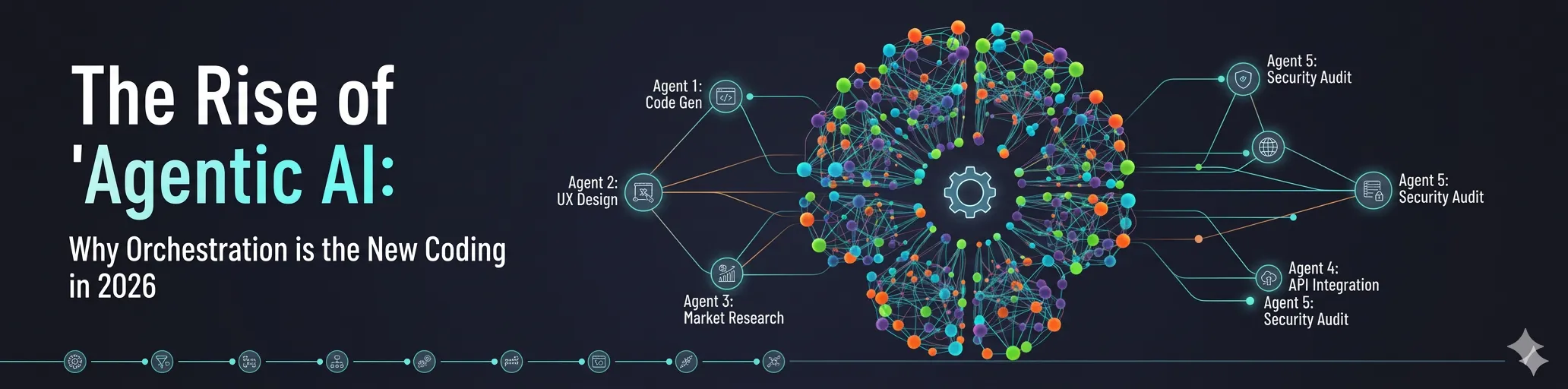
If 2024 was the year we all learned to "chat" with AI, and 2025 was the year businesses started "piloting" it, then 2026 is officially the year of Agentic AI.
For a long time, the advice for early professionals was simple: "Learn to code." But as we look toward the job market of 2026, the mantra has shifted. Today, the most valuable skill isn't just writing the script—it’s Agent Orchestration. Companies are moving away from simple chatbots and toward autonomous AI agents that can plan, execute, and troubleshoot complex workflows on their own.
The gap? We have the agents, but we don't have enough humans who know how to manage them.
From Prompts to Pipelines: The New Workday
In the past, you might have spent four hours writing a Python script or designing a marketing funnel. In 2026, an AI agent does the "doing." Your job is to be the Architect.
Think of it like this: If traditional AI is a calculator, Agentic AI is an employee. It doesn't just give you an answer; it takes an objective (e.g., "Research these 50 competitors and draft a differentiated strategy") and goes off to do it. This shift is creating a massive demand for professionals who understand:
Workflow Design: How to break a big business problem into steps an agent can follow.
Ethics & Oversight: Ensuring the "silicon workforce" doesn't hallucinate or leak data.
Agentic Integration: Connecting AI agents to real-world tools like Slack, Salesforce, and GitHub.
The "Experience Gap": Why Theory is Falling Behind
The biggest challenge for the "Class of 2026" is that most traditional classrooms are still teaching AI as a theoretical concept. But you can't learn orchestration from a textbook.
Industry leaders like Deloitte and PwC are reporting that while 38% of companies are piloting agents, only 11% have them in production. Why? Because they lack people with practical, project-based experience. Employers aren't looking for someone who knows the definition of a "Large Language Model." They want someone who has built a multi-agent system that actually solved a problem.
"In 2026, your portfolio is your degree. If you haven't managed a digital agent, you're effectively digitally illiterate in the eyes of top-tier recruiters."
How to Become an "All-Around Athlete" in 2026
To stay competitive, you need to evolve into what recruiters call an "all-around athlete"—someone who is AI-forward and technically agile. Here is your roadmap:
Learn the "Agentic Stack": Familiarize yourself with frameworks like LangChain or AutoGPT. Understand how agents "think" through reasoning loops.
Master Data Storytelling: Since AI handles the data crunching, your value lies in explaining why the data matters to human stakeholders.
Build "Live" Projects: Don't just follow a tutorial. Try to automate a real task in your life or internship. Build a "Personal Research Agent" or a "Portfolio Optimizer."
Develop Human "Soft" Skills: As AI takes over technical execution, human skills like conflict resolution, empathy, and strategic leadership become your ultimate competitive advantage.
Orchestrate Your Success with GreyLearn
Our students don't just learn about AI—they build autonomous systems in our sandbox environments, giving them the "proof of work" that 2026 employers are desperate for.