The Rise of AI Co-Pilots: Why Every Professional Needs “Prompt Thinking” in 2026
 Grey Learn
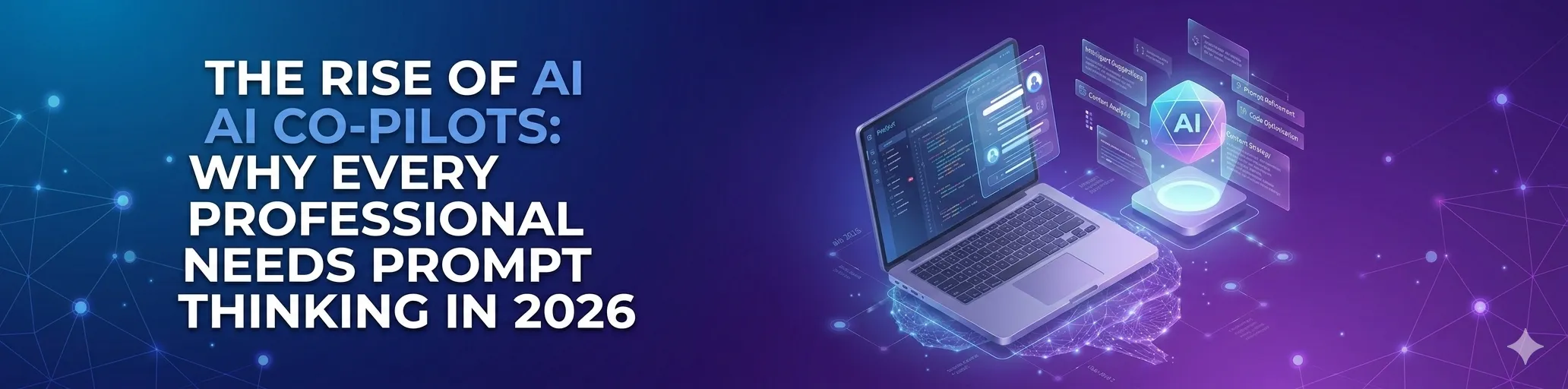
The digital landscape of 2026 looks remarkably different from the speculative years of the early 2020s. Artificial Intelligence is no longer a niche tool limited to data scientists or high-end software engineers. Instead, it has woven itself into the fabric of every professional sector. We have entered the era of AI copilots, where these intelligent assistants act as persistent digital shadows for professionals across the globe. Whether you are a lawyer, a clinician, a marketer, or a student, the ability to work alongside an AI is now as fundamental as the ability to use a keyboard was thirty years ago.
The Copilot Revolution
In 2026, the concept of the "solitary worker" is fading. These tools, integrated directly into our operating systems, email clients, and design suites, are transforming how we learn and solve problems. Unlike traditional software that simply executes a command, an AI copilot suggests improvements, anticipates needs, and handles the "grunt work" that previously consumed 60% of a professional's day.
However, as AI productivity tools become ubiquitous, a clear divide is emerging in the workforce. This divide isn't between those who use AI and those who don’t—everyone uses it. The divide is between those who use it poorly and those who have mastered prompt thinking.
What is Prompt Thinking?
We often hear the term prompt engineering, which refers to the technical act of writing specific inputs to get a desired output. But in 2026, we have moved toward a broader cognitive skill: Prompt Thinking. This is the ability to communicate effectively with an AI system by understanding its logic, its limitations, and its potential.
Prompt thinking isn't about memorizing a set of "magic words." It is a structured way of approaching a problem. Instead of asking a vague question, a professional with prompt thinking skills provides context, intent, and constraints. For example, a beginner asking about cloud computing might get a generic Wikipedia-style summary. A prompt thinker, however, would ask: "Explain cloud computing in simple terms for a beginner who wants to become a cloud engineer, including examples and real-world applications." This shifts the AI from a search engine to a personalized tutor.
How AI Co-Pilots Are Changing Work
The future of work AI is defined by partnership. AI is not replacing the professional; it is elevating the floor of what a professional can achieve.
Developers: In 2026, coding is less about syntax and more about architecture. AI assistants generate the boilerplate code and debug errors in real-time, allowing developers to focus on high-level system design.
Designers: AI tools can generate dozens of layout variations in seconds. The designer’s job has shifted from "making" to "curating"—choosing the best concept and refining it with a human touch.
Marketers: Data analysis that used to take weeks now takes minutes. Marketers use AI to predict customer behavior and generate personalized content at a scale previously impossible.
The Skills Behind Effective AI Collaboration
To excel in this environment, you need more than just a login to an AI platform. AI collaboration requires a specific set of secondary skills:
Instruction Design: The ability to break down a complex task into logical steps that an AI can follow.
Critical Evaluation: AI can "hallucinate" or provide biased information. A professional must act as the ultimate editor, verifying every output against real-world facts.
Workflow Integration: Knowing when to use AI is as important as knowing how. It’s about building a daily routine where AI handles the repetitive tasks, leaving the human brain free for deep, creative thinking.
Why Students and Freshers Should Learn Prompt Thinking
For those entering the workforce in 2026, AI literacy is the new baseline. Employers are no longer impressed that you can use AI; they want to see how you use it to drive value. A junior marketer who can use prompt thinking to generate a data-backed campaign strategy in two hours is worth more than a senior who takes two days to do it manually.
By mastering prompt thinking early, you are not just learning a tool; you are future-proofing your career against the next decade of technological shifts.