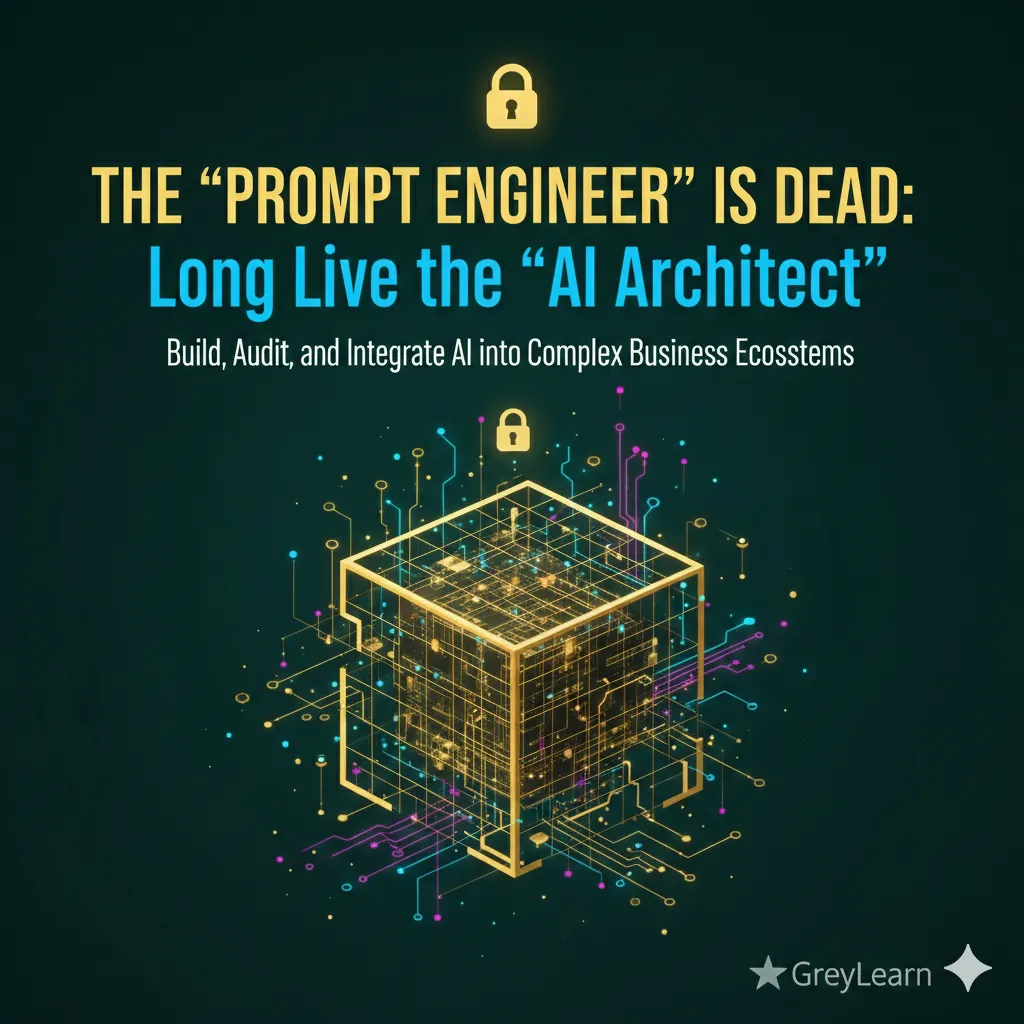
The "Prompt Engineer" is Dead: Long Live the "AI Architect"
 Grey Learn
If you spent 2024 and 2025 mastering the perfect "act as a professional writer" prompt, I have some sobering news for you: by 2026, that skill is reaching its expiration date.
As we move into a new era of generative tech, the industry is shifting away from simple prompt-guessing and toward AI Architecture. Companies are no longer looking for freshers who can "talk" to AI; they are looking for professionals who can build, audit, and integrate AI into complex business ecosystems.
If you’re a student or an early-career professional, here is why you need to move beyond the chat box and start thinking like an architect.
From "User" to "Engineer"
The first wave of AI adoption was about consumption—using tools like ChatGPT or Midjourney to do tasks faster. The 2026 wave is about infrastructure.
In the current job market, a "fresher" is expected to understand how to connect these models to real-world data. It’s the difference between asking an AI to write a summary and building a system that automatically summarizes every incoming customer support ticket, checks it against your company’s database, and drafts a personalized response.
The Skill Shift:
Old Skill: Prompt Engineering (Writing clever text instructions).
New Skill: RAG (Retrieval-Augmented Generation). This is the ability to give AI a "brain" by connecting it to specific, private data sets so it doesn't hallucinate.
The 2026 AI Architect Stack
To stand out in an applicant pool where everyone claims to "know AI," you need to demonstrate technical depth. Here is the stack that will define the next two years:
Vector Databases: Understanding how AI "stores" information (tools like Pinecone or Weaviate).
AI Governance & Ethics: Knowing how to test an AI for bias and ensure it doesn't leak sensitive company data.
Low-Code/No-Code Integration: Using platforms like Make.com or Zapier to chain different AI models together into a "workflow."
API Literacy: Being able to read documentation and connect a piece of software to an LLM (Large Language Model) without breaking the system.
The Reality Check: Why Theory Won't Save You
You can read every whitepaper on LLMs, but until you try to build an AI-powered application, you won't understand the "edge cases." What happens when the AI gives a wrong answer? What happens when the API costs spike?
Employers in 2026 are looking for resilience. They want to see that you've faced a technical hurdle—like an AI model failing to follow instructions—and that you found a structural way to fix it. This is why hands-on projects are the only currency that matters in the new economy.
Master the Architecture with GreyLearn
At GreyLearn, we’ve evolved past basic AI tutorials. Our "AI & Machine Learning Systems" track is built for the 2026 reality. We don't just teach you how to prompt; we teach you how to build end-to-end AI agents, manage vector data, and deploy secure, scalable AI solutions.
The era of the "prompt" is fading. The era of the "architect" has begun. Are you ready to build?
Move beyond the chat box. Join GreyLearn’s program and build the systems of tomorrow.