The "Full-Stack" Fallacy: Why You Need to Become a "Product Engineer" in 2026
 Grey Learn
For a decade, the Full-Stack Developer was the ultimate "Swiss Army Knife" of the tech industry. If you could navigate a database, build an API, and center a div, you were an elite hire.
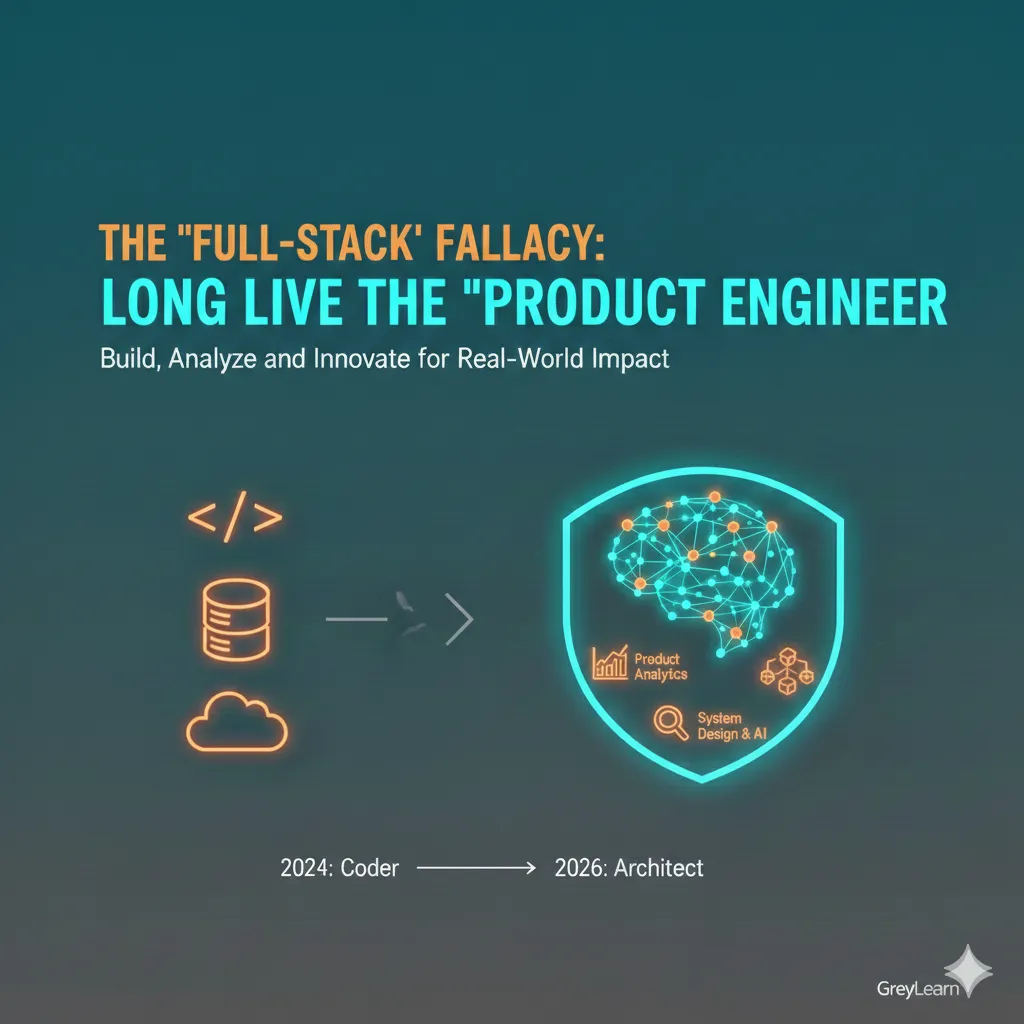
But as we settle into 2026, the "Full-Stack" label is losing its luster. In a world where AI can generate a complete CRUD application from a napkin sketch, "just being able to code" is no longer a competitive advantage—it's the baseline.
Welcome to the era of the Product Engineer.
The Death of the "Code-First" Era
In 2024, the bottleneck was technical execution. In 2026, code is a commodity. With sophisticated AI agents handling boilerplate, refactoring, and unit testing, the hardest part of tech is no longer how to build, but what to build and why.
A Full-Stack Developer waits for a Jira ticket to tell them to "add a search filter." A Product Engineer looks at the data, sees that users are struggling to find products, and proposes a personalized AI-recommendation engine to increase cart value.
The 2026 Product Engineer Skill Stack
To stay indispensable, your toolkit must evolve beyond syntax. The 2026 stack is "human-centric" and "impact-driven":
Product Analytics (The New Console Log): Proficiency in tools like PostHog or Amplitude is now as vital as knowing React. If you can’t measure if your code helped the user, did the code even matter?
UX/UI Literacy: You don't need to be a Figma wizard, but you must understand User Psychology. Why do users drop off? How does cognitive load affect conversion?
AI Orchestration: Instead of writing every function from scratch, you are an architect. You know which LLM API to call, how to manage context windows, and where to use vector databases for RAG (Retrieval-Augmented Generation).
Business Communication: In 2026, the highest-paid engineers are the ones who can explain a technical trade-off to a CEO in terms of ROI (Return on Investment) rather than Latency.
Why "Tutorial Hell" is a Career Trap
Most students are stuck in "Tutorial Hell"—copying code from a screen to build a clone of Netflix or Spotify. The problem? Tutorials teach you mimicry, not problem-solving.
To become a Product Engineer, you need to:
Build something nobody asked for: Solve a personal problem.
Ship it: Get it into the hands of real users.
Watch it fail: Use analytics to see where they got stuck.
Iterate: Fix the product, not just the bugs.
The GreyLearn Edge: Graduate with Impact
At GreyLearn, we recognized this shift early. Our development bootcamps aren't just about learning Python or JavaScript; they are about Product Ownership.
Our students don't just "submit assignments"; they launch Minimum Viable Products (MVPs). They learn to:
Integrate AI to solve actual user pain points.
Analyze user behavior using real-world data.
Pitch their technical solutions like founders.
The industry doesn't need more coders; it needs more builders. Don't get left behind in the "Full-Stack" past.